

OCEAN TECH REVIEW · TOOLS, CFD & RESEARCH
Marine Engineering Resources OpenFOAM, Calculators & Research
Marine engineering resources for engineers, researchers and students. Explore practical calculators, OpenFOAM tutorials and research reviews covering ship design, hydrodynamics, offshore systems and underwater technology. Connect engineering concepts with calculations, simulation workflows and the evidence behind the results.

ENGINEERING CALCULATORS
Marine Engineering Calculators Across 6 Disciplines
Explore marine engineering resources across six practical toolkits for preliminary analysis, technical checks and learning. Work with the inputs, units and assumptions relevant to your task, then follow the calculation into the wider engineering context.
Ship Design & Naval Architecture
Hydrostatics, stability, resistance, propulsion, ship structures and maneuvering calculations.
Explore ship design calculators → 02 SHIP SYSTEMSMarine Machinery & Ship Systems
Marine engines, fuel consumption, electrical systems, power generation and onboard fluid systems.
Explore marine systems → 03 OFFSHORE ENGINEERINGOcean & Offshore Engineering Calculators
Environmental loads, structures, mooring, risers, subsea pipelines, geotechnics and marine operations.
Explore offshore calculators → 04 MARINE ROBOTICSMarine Robotics & Underwater Systems
AUV, ROV and USV calculators, underwater acoustics, battery endurance and subsea physics.
Explore underwater calculators → 05 HYDRODYNAMICS & CFDHydrodynamics, CFD & Experimental Methods
Scaling, towing-tank analysis, wall resolution, time-step estimates, CFD verification and experimental uncertainty.
Explore hydrodynamics calculators → 06 CORE UTILITIESEngineering Fundamentals & Utilities
Unit conversion, mathematics, fluid mechanics, energy and pressure calculations for everyday technical work.
Explore engineering utilities →OPENFOAM & MARINE CFD
OpenFOAM Tutorials for Marine Engineering Workflows
Build the CFD foundations needed to investigate ship flow, waves and offshore hydrodynamics. Start with case organization, solver selection and run control before moving to application-specific modelling. The introductory guides below use OpenFOAM 14 from the OpenFOAM Foundation.
Understand OpenFOAM Case Structure
Explore the 0, constant and system directories through the damBreakLaminar example and learn where fields, models and numerical settings belong.
Read the case structure guide → 02 SOLVER WORKFLOWSExplore Modular Solver Architecture
Understand the role of foamRun and solver modules, and how the OpenFOAM 14 workflow differs from traditional solver applications.
Explore solver architecture → 03 SIMULATION CONTROLConfigure Runs with controlDict
Work through start and stop settings, time-step control and output intervals to understand how a simulation is run and recorded.
Read the controlDict guide →Use the hydrodynamics and CFD calculators alongside these guides to examine scaling, near-wall resolution and time-step estimates. Marine engineering applications also require suitable boundary conditions, verification and reference data.
LATEST FROM OCEAN TECH REVIEW
Latest Marine Engineering Resources & OpenFOAM Guides
Read the latest tutorials, technical articles and research reviews from Ocean Tech Review, from simulation setup and hydrodynamics to vessel design and offshore technology.
-
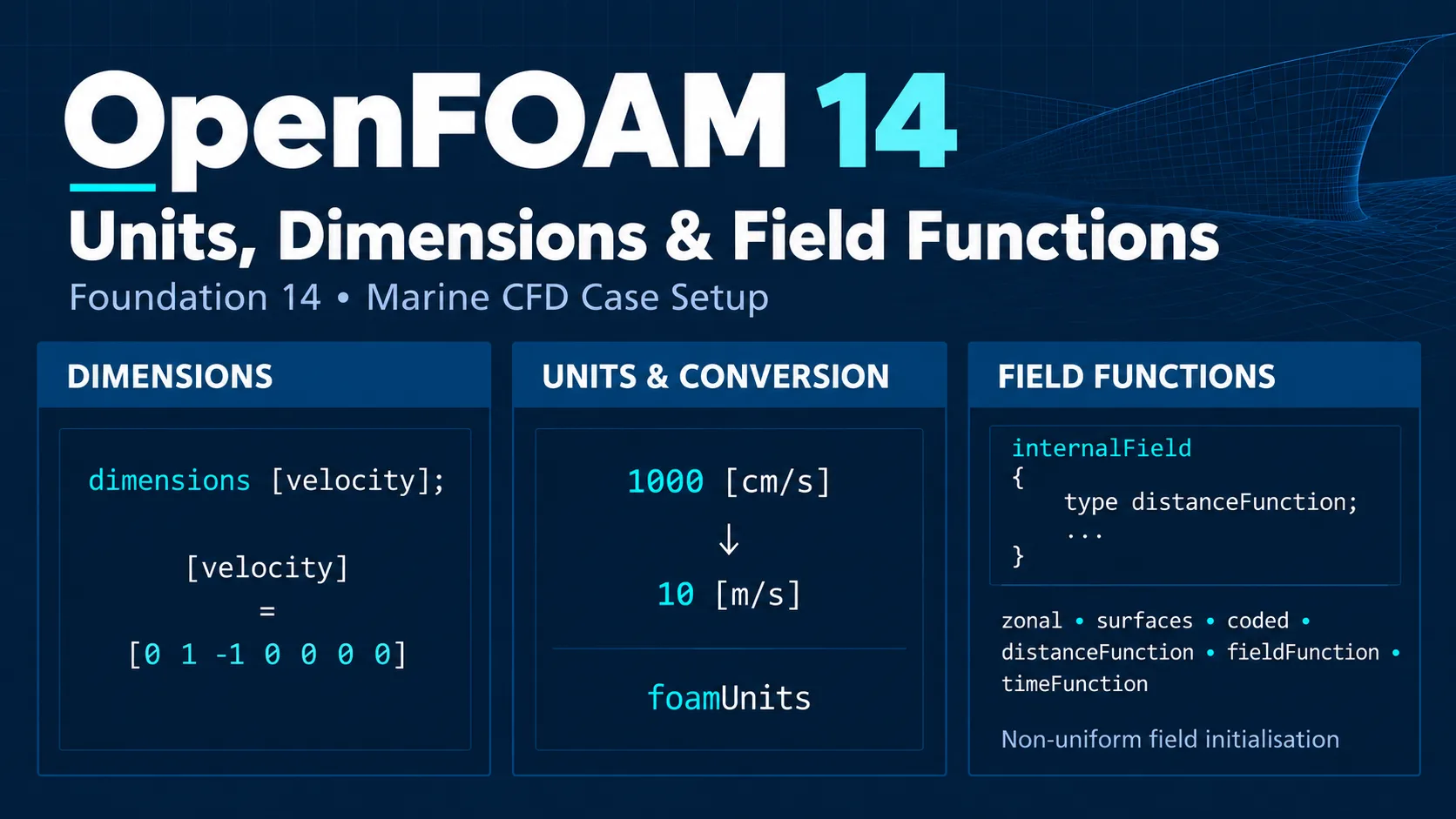
OpenFOAM Units: Dimensions, Conversion & Field Functions in v14
OpenFOAM Units: 6 Essential Field Functions in v14 Table of Contents − 1. Dimensions, Units and Numerical Values Are Different Concepts 2. The Seven Fundamental Dimensions in OpenFOAM 3. Dimensional Consistency Is Not the Same as Physical Correctness 4. Named Dimensions in OpenFOAM 14 5. Do Not Infer Field Dimensions from the Field Name Alone…
-
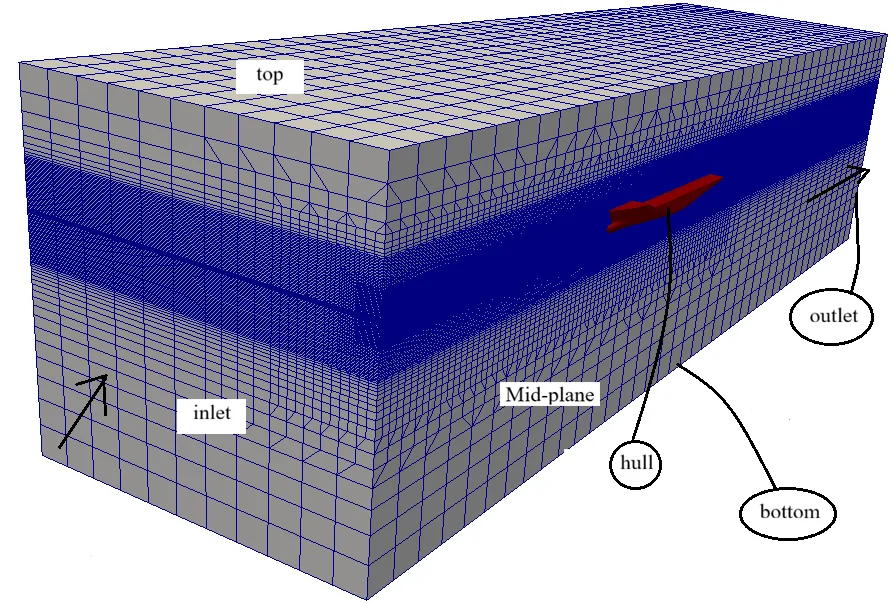
OpenFOAM Boundary Conditions: 10 Best Marine CFD Practices
OpenFOAM Boundary Conditions: 12 Essential Rules for Marine CFD Table of Contents − 1. Where Boundary Conditions Live in OpenFOAM 2. Mesh Patch Type Is Not the Same as a Field Boundary Condition 3. fixedValue: Prescribing a Boundary Value 4. zeroGradient: Zero Normal Gradient at the Boundary 5. Why Velocity and Pressure Boundary Conditions Must…
-
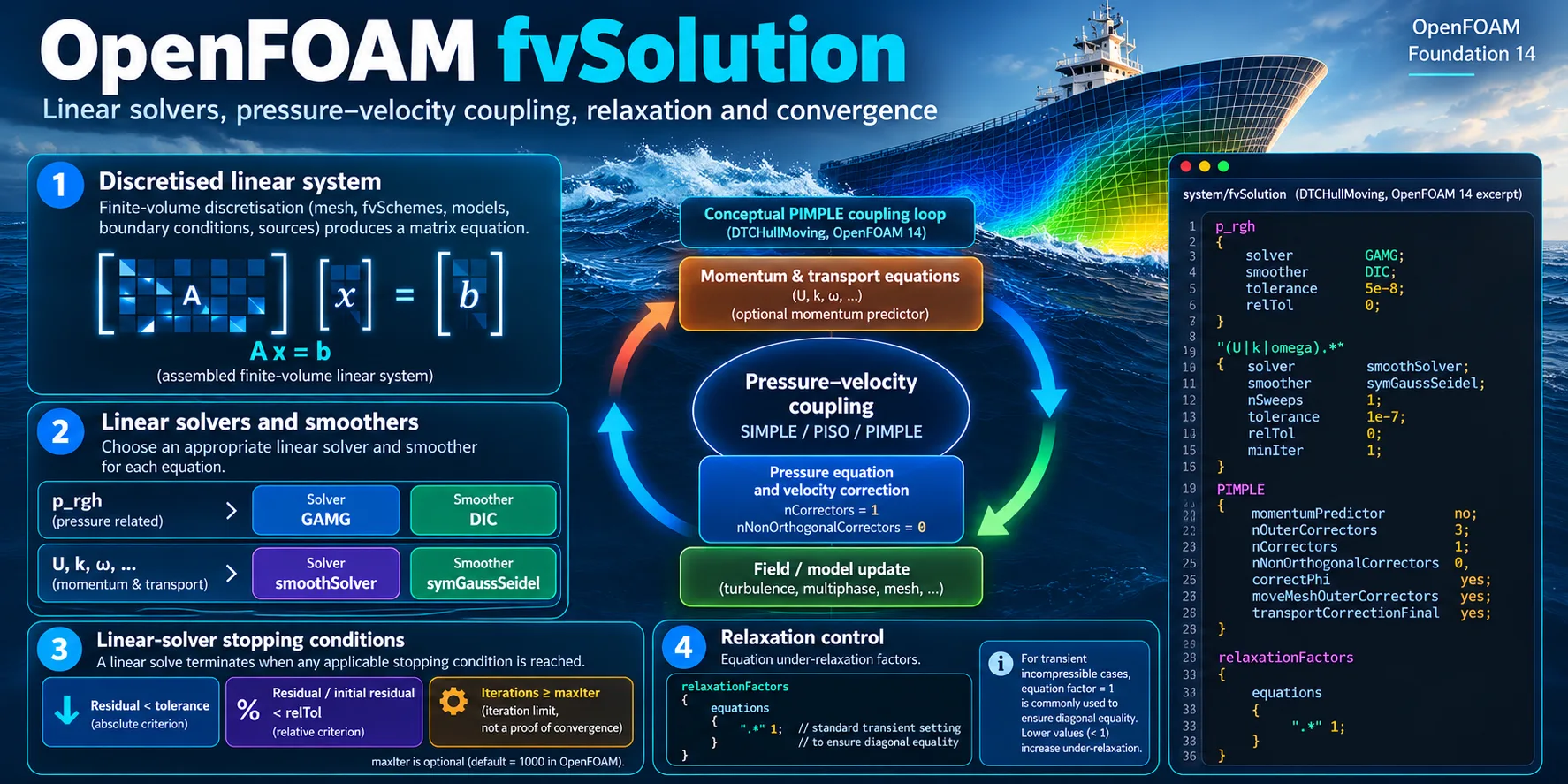
OpenFOAM fvSolution: 12 Essential Settings for Better Marine CFD
OpenFOAM fvSolution: 12 Essential Settings for Better Marine CFD Table of Contents − 1. What fvSolution Controls 2. fvSchemes vs fvSolution 3. Foundation 14 DTCHullMoving as the Working Example 4. From a Discretised Equation to Ax = b 5. Linear Solver Families and Matrix Symmetry 6. Preconditioners and Smoothers Are Different 7. smoothSolver and nSweeps…
RESEARCH & TECHNICAL RESOURCES
Research Reviews & Applied Engineering Projects
Explore marine engineering resources that connect research with practice. Reviews examine published evidence, while project resources explain modelling choices, calculations and practical design questions.
Research Reviews
Explore research methods, findings and limitations relevant to ship hydrodynamics, ocean technology and numerical analysis.
Explore research reviews →Naval Architecture Projects
Explore ship hydrodynamics, hull development, vessel design and software workflows, with attention to assumptions, checks and interpretation.
View projects →TECHNICAL COVERAGE
From Engineering Fundamentals to Marine CFD
Marine engineering brings together vessel design, machinery, ocean environments and underwater systems. OpenFOAM and other computational methods provide one route to studying fluid behaviour. Calculators, physical testing and research literature help place those numerical results in context.
ABOUT OCEAN TECH REVIEW
Independent Marine Engineering Resources
Ocean Tech Review brings together engineering calculators, technical articles, OpenFOAM tutorials and research-focused analysis for readers working with ships, offshore structures and ocean systems.
Use the platform to connect a practical question with the relevant relationships, units and modelling choices. When interpreting a calculation or simulation, consider its assumptions, software version and the evidence available to assess its accuracy.
Learn more about Ocean Tech ReviewFURTHER READING
Official OpenFOAM Documentation
Consult the OpenFOAM Foundation user guide for Foundation releases and the OpenCFD user guide for the OpenCFD distribution. Match each tutorial to its stated release; solver names, settings and available features can differ.
CONTACT
Discuss a Technical Question or Collaboration
Share questions about our marine engineering resources, OpenFOAM workflows or research methods. Technical corrections and proposals for collaboration are welcome.